From Detection to Exploitation: How Kai Verifies Vulnerabilities
Finding potential vulnerabilities is only half the battle. The real challenge is proving that a vulnerability is exploitable. This is where Kai's approach differs fundamentally from traditional static analysis tools.
The False Positive Problem
Every security professional knows the frustration of false positives. Traditional static analysis tools are notorious for generating hundreds of warnings, most of which are:
- Theoretical but impractical - Requires impossible preconditions
- Already mitigated - Protected by checks the tool doesn't understand
- Intentional behavior - By design, not by accident
This noise is expensive. Engineering teams spend hours triaging warnings that turn out to be nothing, developing "alert fatigue" that causes real issues to be overlooked.
Kai's Verification Pipeline
Kai takes a fundamentally different approach: every reported vulnerability comes with working proof.
Step 1: Candidate Discovery
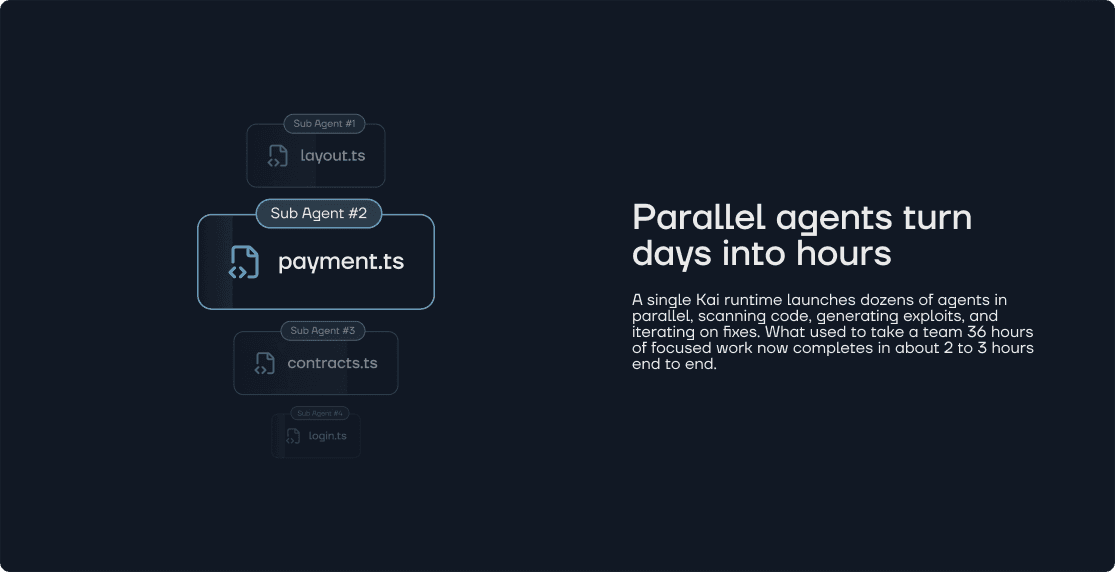
Our AI agents explore the codebase looking for potential violations:
StateAgent → Discovers state manipulation opportunities
QuantAgent → Identifies numerical edge cases
AccessAgent → Probes permission boundaries
Each agent generates exploit candidates—hypotheses about what might be vulnerable.
Step 2: Exploit Synthesis
For each candidate, Kai attempts to synthesize a working exploit:
// Example: Generated PoC for reentrancy vulnerability
function exploit() external {
    // Setup attack contract
    AttackContract attack = new AttackContract(target);

    // Fund the attack
    attack.deposit{value: 1 ether}();

    // Execute exploit
    attack.attack();

    // Verify success
    assert(address(attack).balance > 1 ether);
}
Step 3: Execution and Validation
The synthesized exploit is executed against a forked state:
- Deploy attack contracts
- Run the exploit transaction
- Verify that invariants were violated
- Measure the economic impact
Only exploits that actually work are reported.
Case Study: Successful Verification
In a recent audit, Kai discovered 10 potential exploit candidates. Here's what the verification process revealed:
| Candidate | Verification Result | Outcome |
|---|---|---|
| Stale confirmations | ✅ Exploit works | Verified Bug |
| Access control bypass | ❌ Reverts on check | False Positive |
| Integer overflow | ❌ SafeMath protects | False Positive |
| Reentrancy in withdraw | ❌ Guard prevents | False Positive |
| Price manipulation | ❌ Oracle validates | False Positive |
One verified vulnerability is worth more than a hundred theoretical warnings.
Why This Matters
For Developers
No more chasing ghosts. Every Kai finding is:
- Proven exploitable
- Accompanied by reproduction code
- Clearly explained with impact analysis
For Protocols
Security reports are actionable. You know:
- Exactly what's vulnerable
- How an attacker would exploit it
- What the fix should look like
For the Ecosystem
Resources are focused where they matter. Auditors spend time on real issues, not noise.
The Technical Implementation
Kai's verification uses several advanced techniques:
Symbolic Execution: Explore all possible execution paths mathematically
Fuzzing: Generate random inputs to trigger edge cases
Formal Methods: Prove properties about code behavior
LLM Reasoning: Understand semantic meaning and generate targeted attacks
Together, these approaches create a verification system that's both comprehensive and precise.
Getting Started
Ready to see verification in action? Kai can analyze your codebase and provide:
- Verified vulnerabilities with PoC code
- Clear severity assessments
- Recommended fixes with diffs
No more false positives. Just real security findings.
Experience proof-based security with Kai.